
When water damages a home or business, getting the water out is only the beginning.
Water extraction, moisture detection, and structural drying are critical first steps. But if drywall, flooring, ceilings, insulation, trim, cabinets, or other materials had to be removed, the property still needs to be repaired.
That next phase is water damage repair and reconstruction.
At Best Option Restoration of Colorado Springs, our IICRC-certified team can manage the restoration process from emergency water mitigation and structural drying through drywall, texture, paint, flooring, tile, trim, and final reconstruction.
That means homeowners, landlords, property managers, and businesses can work with one local restoration company from the initial water damage through the finished rebuild.
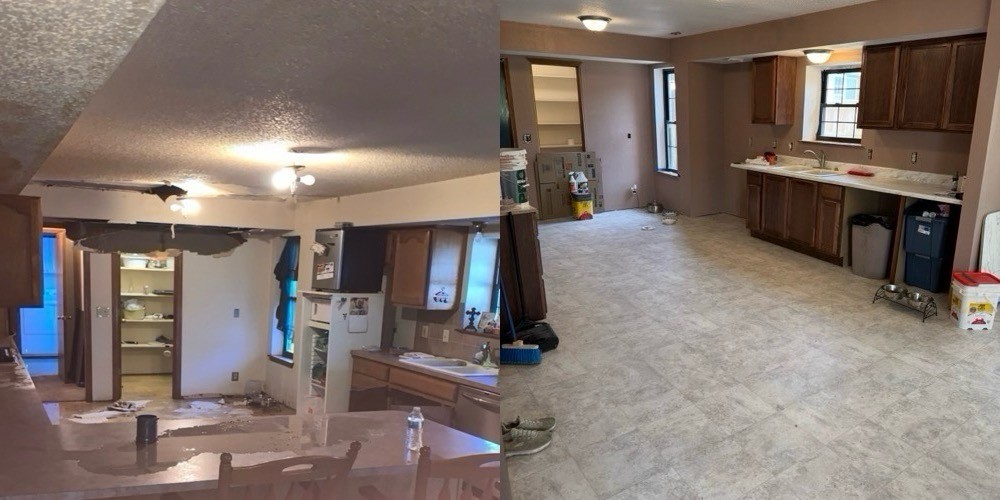
The before-and-after photo in this article shows why that matters.
A property may look dramatically different during mitigation because damaged materials sometimes have to be opened or removed so the structure can be properly dried. Reconstruction is what takes the property from damaged and disrupted back to a finished, usable space.
Drying the property is an important milestone. Getting the property back together is the goal.
Quick Answer: What Happens After Water Damage Mitigation?
Once standing water has been removed and the affected structure has been properly dried, the restoration company determines what materials need to be repaired or replaced.
Depending on the water loss, reconstruction may include:
- Drywall repair or replacement
- Ceiling repair
- Texture matching
- Interior painting
- Flooring replacement
- Tile installation
- Baseboards and trim
- Insulation replacement
- Cabinet-related repairs
- Framing repairs
- Finish carpentry
Not every water-damage project requires major reconstruction.
The amount of repair depends on where the water traveled, what materials were affected, what could be successfully dried, and what had to be removed during mitigation.
What Is Water Damage Reconstruction?
Water damage reconstruction is the rebuilding and repair work performed after the immediate water problem has been controlled and the structure is ready for repairs.
Homeowners often search for terms such as:
- water damage repair Colorado Springs
- water damage reconstruction Colorado Springs
- water damage restoration Colorado Springs
Although these phrases overlap, they describe different portions of the recovery process.
Water mitigation stops additional damage and dries the property. Water damage reconstruction puts the affected areas back together.
Water Mitigation vs. Water Damage Restoration vs. Reconstruction
These terms are often used interchangeably, but they are not exactly the same.
Water Mitigation
Water mitigation focuses on limiting additional damage after a water loss. Depending on the situation, it may include:
- Emergency water extraction
- Moisture detection
- Removal of standing water
- Removing materials that cannot be saved
- Air movers and dehumidification
- Structural drying
- Moisture monitoring
Water Damage Restoration
Water damage restoration is the broader process of returning the property to its pre-loss condition. It can include mitigation, drying, cleaning, repairs, and reconstruction.
Water Damage Reconstruction
Reconstruction is the repair and rebuilding stage after mitigation. This can include replacing drywall, flooring, ceilings, trim, tile, paint, cabinets, and other materials affected by the loss.
At Best Option Restoration of Colorado Springs, we can handle all three stages.
Why This Matters to Colorado Springs Homeowners
One of the most frustrating moments after water damage can happen when the drying equipment is removed.
The homeowner believes the restoration is almost finished—only to learn that they now need to locate a separate contractor to rebuild the room.
That can mean:
- Another estimate
- Another contractor
- Another schedule
- Another walkthrough
- Another company that has to learn what happened during the original water loss
With Best Option Restoration of Colorado Springs, the same restoration company can continue from the mitigation phase into the reconstruction phase.
That continuity can simplify communication, documentation, scheduling, and the overall recovery process.
Step 1: Make Sure the Structure Is Ready to Rebuild
Reconstruction should not begin simply because the walls or flooring look dry.
Water can travel into areas that are difficult to see, including:
- Wall cavities
- Subflooring
- Framing
- Insulation
- Areas beneath finished flooring
- Around baseboards
- Beneath cabinets
Professional structural drying in Colorado Springs may involve moisture meters, drying equipment, dehumidification, moisture mapping, and ongoing monitoring.
The purpose is to determine whether affected materials are ready for reconstruction—not simply whether the surface feels dry.
Installing new drywall, flooring, or paint over materials that still contain excess moisture can conceal a problem instead of solving it.
For a more detailed explanation of this stage, read our guide on Water Damage Restoration Process: What Actually Happens in Your Colorado Springs Home.
Step 2: Determine What Can Be Saved
Water damage does not automatically mean everything needs to be torn out.
Depending on the circumstances, some materials may be successfully dried and retained. Other materials may require removal because of:
- Extent of saturation
- Type of water involved
- Length of exposure
- Physical deterioration
- Contamination
- Mold growth
- Inability to dry the material adequately
Materials commonly evaluated after water damage include drywall, insulation, carpet, padding, flooring, subflooring, ceilings, baseboards, cabinetry, framing, and trim.
At Best Option Restoration of Colorado Springs, we believe restoration should be based on what the property actually needs. Unnecessary demolition does not make a restoration project better. Every material unnecessarily removed is another material that eventually has to be replaced.
Does Wet Drywall Always Need to Be Removed?
No.
Whether wet drywall can be dried or needs to be removed depends on several factors, including:
- The source of the water
- Amount of moisture absorbed
- How long the drywall remained wet
- Condition of the drywall
- Whether insulation behind it is affected
- Contamination concerns
- Whether mold is present
Drywall that has lost its integrity, is contaminated, contains mold growth, or cannot be adequately dried may need to be removed. Other drywall may sometimes be dried without removing the entire wall.
That is why professional moisture evaluation should come before unnecessary demolition.
Step 3: Develop the Water Damage Repair Scope
Once the structure is ready and the materials requiring replacement have been identified, the reconstruction scope can be developed.
A water damage repair in Colorado Springs may include:
- Drywall: replacing areas removed during mitigation.
- Texture: matching surrounding wall or ceiling finishes.
- Painting: preparing and repainting repaired areas.
- Flooring: repairing or replacing affected flooring.
- Tile: restoring tiled areas when necessary.
- Trim: replacing baseboards, casing, and other finish materials.
- Ceilings: repairing areas affected by roof leaks, plumbing losses, or water from upper floors.
- Cabinetry and finish work: addressing affected components when they are part of the reconstruction scope.
The goal is not simply to cover an opening in a wall. The goal is to return the property to a finished, functional condition.
Step 4: Repair Walls and Ceilings
Drywall and ceiling repair are among the most common reconstruction needs after water damage.
A broken supply line, roof leak, plumbing failure, appliance leak, or water from an upper level can damage building materials beyond the point where the water first appears.
When drywall has to be removed, reconstruction may involve:
- New drywall
- Drywall finishing
- Texture matching
- Priming
- Painting
The finished repair matters. A homeowner should not be left with a dry property that still looks like a construction zone.
Step 5: Repair or Replace Flooring
Water frequently travels under finished flooring.
Depending on the loss, the restoration team may have to evaluate:
- Carpet
- Carpet padding
- Laminate
- Hardwood
- Luxury vinyl
- Tile
- Subflooring
Some materials may be salvageable; others may need to be replaced. The type of flooring, source of the water, length of exposure, amount of saturation, and condition of the subfloor all affect that decision.
Step 6: Finish the Reconstruction
The final stage is what transforms the property from a restoration project back into a home or usable business.
Depending on the loss, this may include:
- Drywall
- Texture
- Painting
- Flooring
- Tile
- Baseboards
- Trim
- Finish work
This is one of Best Option Restoration of Colorado Springs’ biggest advantages: We do not have to stop when the drying equipment leaves. Our team can continue through the reconstruction required to finish the property.
Before and After Water Damage Restoration in Colorado Springs
The before-and-after photograph accompanying this article demonstrates an important part of the restoration process.
The before image shows what a property can look like after affected finishes have been opened or removed. The after image shows what homeowners ultimately want to see: a completed space again.
That is why water damage restoration should not be viewed as simply removing water. It is a recovery process:
Damaged → Dry → Repaired → Finished
For the homeowner, the final step matters just as much as the first.
Why Choose One Company for Mitigation and Reconstruction?
There are real advantages to having one restoration company manage both phases.
The team performing the reconstruction already understands:
- Where the water traveled
- What materials were affected
- What was removed
- How the structure was dried
- What documentation was created
- What repairs remain
That can reduce communication gaps between the mitigation contractor and the reconstruction contractor.
At Best Option Restoration of Colorado Springs, our team can manage:
Emergency response → water extraction → moisture detection → structural drying → damaged-material removal → reconstruction → final repairs
One company. One restoration process. One path back to a finished property.
Common Causes of Water Damage That May Require Reconstruction
Burst Pipes
A burst or leaking pipe can affect walls, insulation, ceilings, flooring, cabinets, and multiple rooms before the water is shut off.
Water Heater Failures
A leaking or failed water heater can damage flooring, drywall, baseboards, and surrounding rooms.
Appliance Leaks
Washing machines, dishwashers, refrigerators, and other appliances can damage flooring, cabinetry, walls, and subflooring.
Basement Flooding
Finished basements can experience damage to drywall, insulation, flooring, carpet, trim, and stored belongings.
Roof and Window Leaks
Water entering through a roof or window can affect ceilings, walls, insulation, flooring, framing, and paint.
Sewage Backups
Contaminated water may require removal of porous materials before the affected areas can be reconstructed.
What If Mold Is Found During the Water Damage Restoration?
Water damage and mold remediation often overlap.
If mold growth develops in affected building materials, the mold issue may need to be addressed before reconstruction begins.
Professional mold remediation in Colorado Springs may include containment, HEPA air filtration, cleaning or removal of affected materials, moisture correction, structural drying, and reconstruction.
Because Best Option Restoration of Colorado Springs provides both water damage restoration and mold remediation, the two portions of the project can be coordinated.
For a detailed explanation, read our guide on What Happens During Mold Remediation in Colorado Springs? A Step-by-Step Guide.
How Much Does Water Damage Repair and Reconstruction Cost in Colorado Springs?
There is no single price for every water-damage project. The cost depends on factors such as:
- Size of the affected area
- Type of materials damaged
- Amount of removal required
- Flooring involvement
- Cabinet involvement
- Tile or specialty finishes
- Structural repairs
- Material selections
- Mold remediation, if necessary
- Overall reconstruction scope
This is why relying on generic online water-damage cost estimates can be misleading. Two homes can experience the same type of leak and require very different levels of repair.
Best Option Restoration of Colorado Springs evaluates the actual conditions and needed repairs before determining the reconstruction scope.
Does Homeowners Insurance Cover Water Damage Reconstruction?
Sometimes.
Coverage depends on the cause of the water loss and the terms of the insurance policy. A sudden accidental water loss may be treated differently from long-term leakage, maintenance issues, groundwater, flooding, or other excluded causes.
The insurance carrier ultimately determines coverage. For an applicable insurance claim, Best Option Restoration of Colorado Springs can assist with restoration documentation such as:
- Damage photographs
- Moisture readings
- Scope information
- Estimates
- Affected materials
- Reconstruction requirements
- Communication with the adjuster when needed
Clear documentation can help create a record of what occurred and what work was necessary.
Water Damage Repair for Landlords and Property Managers
Rental-property water damage adds another layer of responsibility. Landlords and property managers may need to coordinate:
- Tenant communication
- Property access
- Restoration schedules
- Damage documentation
- Progress photographs
- Insurance information
- Reconstruction timelines
Best Option Restoration of Colorado Springs works with landlords and property managers through water mitigation, structural drying, documentation, and reconstruction. Whether you own one rental home or manage multiple properties, knowing what is happening at the property throughout the restoration process matters.
Commercial Water Damage Repair and Reconstruction in Colorado Springs
Water damage also affects businesses, offices, retail spaces, multi-unit properties, and other commercial buildings. For businesses, every day of disruption can matter.
Commercial water restoration may involve:
- Emergency water extraction
- Moisture detection
- Structural drying
- Documentation
- Coordinating around business operations
- Repairing walls, ceilings, flooring, and finishes
- Complete reconstruction
Best Option Restoration of Colorado Springs provides commercial water damage restoration and reconstruction with an emphasis on clear communication and moving the property toward a usable condition again.
What Should You Look for in a Water Damage Restoration Company?
Before hiring a restoration company, ask:
- Do you handle both mitigation and reconstruction?
- How do you determine what can be saved?
- How do you confirm materials are dry?
- Do you document the water damage?
- Can you repair drywall, flooring, tile, texture, and paint?
- Can you assist with insurance documentation?
- Who will communicate with me during the project?
Those questions help homeowners evaluate more than the initial emergency response. They help determine whether the company can manage the entire recovery process.
Frequently Asked Questions About Water Damage Repair in Colorado Springs
Is water damage repair the same as water damage restoration?
Not exactly. Water damage restoration describes the broader recovery process. Water damage repair and reconstruction refer more specifically to rebuilding damaged or removed building materials.
Does wet drywall always have to be replaced?
No. The decision depends on the water source, extent of saturation, duration of exposure, condition of the material, contamination, moisture levels, and whether mold is present.
Can flooring be saved after water damage?
Sometimes. The flooring type, amount and source of the water, length of exposure, and condition of the subfloor help determine whether flooring can be restored or should be replaced.
What happens after the drying equipment is removed?
Once affected materials are appropriately dried, repairs and reconstruction can begin. This may include drywall, texture, painting, flooring, tile, trim, and other finish work.
Can one company dry and rebuild my home?
Yes. Best Option Restoration of Colorado Springs provides water mitigation, structural drying, water damage restoration, and complete reconstruction, allowing one company to manage the project from the initial emergency through final repairs.
Can you rebuild after mold remediation?
Yes. When water damage also creates a mold problem, we can handle the remediation and continue through the required reconstruction.
Do you provide commercial water damage reconstruction?
Yes. We work with homeowners, landlords, property managers, businesses, offices, rental properties, and other commercial spaces.
Need Water Damage Repair or Reconstruction in Colorado Springs?
When water damages your property, removing the water is only the beginning.
A complete restoration may require water extraction, moisture detection, structural drying, removal of affected materials, drywall repair, flooring, painting, tile, trim, and complete reconstruction.
At Best Option Restoration of Colorado Springs, our IICRC-certified team can manage those stages under one roof.
Whether the damage came from a burst pipe, water heater failure, appliance leak, basement flood, roof leak, or another water loss, our goal is to help take the property from:
Damaged → Dry → Repaired → Finished
Best Option Restoration of Colorado Springs
- 24/7 Water Damage Restoration
- Structural Drying
- Water Damage Repair
- Complete Reconstruction
Contact us for help with water damage restoration, repair, and reconstruction in Colorado Springs.