
If mold keeps coming back after you clean it, the real problem is usually not the cleaner you used. It is often a sign that moisture is still present somewhere in the home or building.
For many Colorado Springs homeowners, business owners, and property managers, recurring mold can be frustrating because it looks like a surface problem at first. You wipe it down, spray it, scrub it, or paint over it, and the area may look better for a short time. Then the staining, spots, or musty odor comes back.
That usually means the source of the problem was never fully corrected.
The EPA says the key to mold control is moisture control. If mold is a problem, the mold should be cleaned up and the water problem should be fixed. The EPA also recommends drying wet or water-damaged areas and materials within 24 to 48 hours after a leak or spill to help prevent mold growth.
For Colorado Springs properties, this matters because mold is often connected to hidden water damage, plumbing leaks, appliance leaks, roof leaks, foundation moisture, poor ventilation, high indoor humidity, or damp building materials that were never properly dried.
Mold Does Not Need a Major Flood to Grow
Many people think mold only happens after a major flood or large water loss. In reality, mold can grow anywhere there is enough moisture.
A slow leak under a sink, a loose toilet supply line, a leaking washing machine hose, a dishwasher leak, a water heater issue, condensation around windows, or a damp basement wall can create the right conditions for mold.
The CDC explains that mold grows where moisture is present, including around leaks in roofs, windows, or pipes, or where flooding has occurred. Mold can grow on materials such as paper, cardboard, ceiling tiles, wood, dust, paint, wallpaper, insulation, drywall, carpet, fabric, and upholstery.
That is why recurring mold often shows up in bathrooms, basements, crawl spaces, laundry rooms, utility rooms, under sinks, around windows, behind drywall, along baseboards, under flooring, near water heaters, commercial restrooms, office storage areas, break rooms, mechanical rooms, and tenant spaces.
Even in a drier climate like Colorado Springs, indoor mold can still become a problem when moisture is trapped inside a structure.
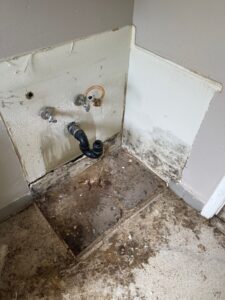
Why Mold Returns in the Same Spot
When mold keeps coming back in the same area, it usually means one of three things is happening.
First, the moisture source may still be active. This could be a plumbing leak, roof leak, appliance leak, toilet overflow, condensation issue, poor ventilation, basement moisture, crawl space moisture, or water intrusion through a foundation or exterior wall.
Second, the affected material may still be damp. Drywall, insulation, wood, cabinets, baseboards, subflooring, and flooring materials can hold moisture even after the surface looks dry.
Third, the visible mold may have been cleaned, but the affected porous material was not properly addressed. Surface cleaning can remove what you see, but it may not solve the deeper moisture problem feeding the growth.
This is why professional mold remediation is different from basic cleaning. The goal is not just to make the wall, cabinet, or baseboard look better. The goal is to identify the moisture source, evaluate affected materials, dry the structure properly, and reduce the chance of mold returning.
Why DIY Mold Cleaning Often Fails
Most DIY mold cleaning focuses on what is visible. That can help in some small, surface-level situations, especially on hard, non-porous materials. But when mold keeps returning, the issue is usually deeper than the surface.
If the source is a plumbing leak, appliance leak, roof leak, poor ventilation, damp drywall, wet insulation, or water damage that was never fully dried, the mold may return no matter how many times the surface is cleaned.
DIY cleaning can also miss moisture trapped behind walls, under flooring, inside cabinets, around baseboards, or in porous materials. Mold on drywall, carpet, insulation, wood, or ceiling materials is different from surface staining on a hard material.
Painting over mold is another common mistake. Paint may temporarily cover staining, but it does not remove mold growth or correct the moisture source. If the material behind the paint is still damp, the problem can continue.
That is why recurring mold should not be treated as just a cleaning problem. It should be treated as a moisture problem, a water damage problem, or a building materials problem until proven otherwise.
The Water Damage Connection
Recurring mold and water damage are often connected.
When water enters a property, it can spread quickly into places homeowners and business owners cannot easily see. Moisture can move behind walls, under flooring, into cabinets, beneath baseboards, around insulation, and into building materials.
This is why water damage restoration in Colorado Springs matters so much. Removing visible water is only one part of the process. Hidden moisture can remain inside the structure, and if it is not addressed, mold may begin to grow.
Common water damage situations that can lead to mold include plumbing leaks, appliance leaks, washing machine overflows, dishwasher leaks, toilet overflows, water heater leaks, roof leaks, window leaks, basement moisture, crawl space moisture, sump pump issues, storm-related water intrusion, and improperly dried past water damage.
For homes and commercial spaces in Colorado Springs, early action can make a major difference. The longer moisture sits, the greater the chance that water damage turns into a mold concern.
Warning Signs That Mold May Be Coming From Hidden Moisture
Mold is not always obvious right away. Sometimes the first sign is a musty smell.
A musty odor in a bathroom, basement, crawl space, laundry room, storage room, office, restroom, or utility area can be a warning that moisture is still present.
Other warning signs include staining, bubbling paint, peeling paint, soft drywall, warped flooring, swollen baseboards, damp cabinets, discoloration around windows, moisture around a water heater, or mold that returns days or weeks after cleaning.
For commercial properties, recurring mold may also show up as tenant complaints, employee concerns, persistent odors, visible staining, or repeated maintenance issues in the same area.
If the same spot keeps needing to be cleaned, it is usually time to look deeper.
Humidity Can Also Contribute to Mold
Mold does not always require a pipe burst or major leak. High indoor humidity can also create conditions where mold is more likely to grow.
The EPA recommends keeping indoor relative humidity below 60 percent, and ideally between 30 and 50 percent when possible.
This can be especially important in bathrooms, laundry rooms, basements, crawl spaces, commercial restrooms, break rooms, tenant spaces, and areas with poor airflow.
A simple humidity meter can help homeowners and property managers monitor indoor humidity, but humidity readings do not replace a professional moisture inspection when water damage or hidden moisture is suspected.
Mold in Homes and Commercial Spaces
Mold is not just a residential problem. Business owners and property managers also need to pay attention to recurring mold because it can affect tenants, employees, customers, inventory, building materials, and day-to-day operations.
In commercial spaces, mold concerns often appear in restrooms, janitorial closets, storage areas, break rooms, offices, mechanical rooms, ceiling areas below roof leaks, and walls near plumbing lines or HVAC-related moisture.
For property managers, the challenge is often documentation, speed, communication, and limiting disruption. A small leak in one unit, office, or tenant space can become a bigger issue if moisture spreads into shared walls, flooring systems, or adjoining areas.
That is why recurring mold should not be treated as only a cleaning issue. It should be treated as a possible moisture, water damage, or building materials issue.
Do You Need Mold Testing?
Many people ask whether they need mold testing before mold remediation. The answer depends on the situation.
The EPA says that in most cases, if visible mold growth is present, sampling is unnecessary. The EPA also notes that no federal limits have been set for mold or mold spores, so sampling cannot be used to determine whether a building meets a federal mold standard.
That does not mean mold testing is never helpful.
Testing may be useful when there is a musty odor but no visible mold, when documentation is needed, when a real estate transaction, tenant concern, insurance situation, or commercial property requires more information, or when post-remediation clearance testing is requested.
Depending on the situation, reputable mold testing companies may use several types of testing or inspection methods:
Air sampling: Air samples may be collected indoors and sometimes compared with outdoor air samples to help evaluate airborne mold spores at the time of testing. Air sampling can be useful in certain situations, but it is only a snapshot in time.
Surface sampling: Surface testing may include swab samples or tape-lift samples from a specific surface. This can help identify whether mold-like growth is present on a material or help evaluate whether an area has been adequately cleaned or remediated.
Bulk or material sampling: In some cases, a testing company may collect a small piece of material, such as drywall, insulation, carpet, or another affected building material, for lab analysis. This may help document whether the material itself is contaminated.
Moisture inspection: While this is not a mold lab test, it is one of the most important parts of finding the cause. Moisture meters, thermal imaging, and visual inspection may help locate hidden moisture behind walls, under flooring, around baseboards, near plumbing, or inside building materials.
Post-remediation clearance testing: After remediation, some homeowners, property managers, insurance companies, or commercial clients may request clearance testing or third-party documentation. This may involve a visual inspection, moisture verification, surface sampling, air sampling, or a combination of methods, depending on the property and the testing company.
At Best Option Restoration of Colorado Springs, we work with reputable mold testing companies when testing is appropriate. This helps provide an added layer of documentation and gives homeowners, business owners, and property managers more confidence in the next steps.
When mold is clearly visible, the priority is usually to identify the moisture source, address affected materials, dry the structure properly, and remediate the impacted area. Testing can support the process, but correcting the moisture problem is what helps keep mold from coming back.
Is It “Black Mold”?
Searches for black mold removal Colorado Springs are common, but color alone does not tell you everything you need to know.
Some molds are dark, some are green, some are gray, and some are not easy to identify visually. The more important question is not just what color the mold is. The more important question is: why is it growing there?
If there is moisture, water damage, a leak, damp building materials, or poor ventilation, the source needs to be addressed.
Whether you call it black mold, visible mold, recurring mold, or mold after water damage, the next step is the same: find the moisture source, evaluate the affected materials, and address the problem correctly.
Health and Indoor Air Quality Concerns
Mold affects people differently. Some people may have no symptoms, while others may experience irritation or allergy-like symptoms.
The CDC says mold may cause symptoms such as stuffy nose, sore throat, coughing, wheezing, burning eyes, or skin rash for some people. People with asthma, mold allergies, weakened immune systems, or chronic lung disease may have stronger reactions.
This is one reason recurring mold should not be ignored, especially in homes with children, older adults, pets, people with allergies, or people with asthma. In commercial spaces, mold concerns can also affect employees, tenants, customers, and visitors.
Mold Removal vs. Mold Remediation
People often use mold removal and mold remediation as if they mean the same thing, but there is an important difference.
Mold removal usually refers to removing visible mold from a surface.
Mold remediation is more complete. It focuses on the moisture source, affected materials, surrounding conditions, and the reason mold was able to grow in the first place.
Professional mold remediation may include moisture investigation, containment, removal of impacted porous materials, cleaning of salvageable surfaces, air filtration, drying, documentation, and steps to help reduce the chance of mold returning.
The ANSI/IICRC S520 Standard for Professional Mold Remediation describes procedures and precautions for mold remediation in residential, commercial, and institutional buildings.
For recurring mold, remediation matters because the goal is not just to clean what is visible. The goal is to address why mold came back.
Why Colorado Springs Properties Can Still Have Mold Problems
Colorado Springs may have a drier climate than many other parts of the country, but mold is still a real concern when water enters a building or humidity becomes trapped indoors.
A dry outdoor climate does not prevent mold behind a damp wall, under wet flooring, inside a cabinet, around a leaking water heater, or in a poorly ventilated bathroom.
Homes and commercial properties throughout Colorado Springs, Briargate, Powers, Broadmoor, Old Colorado City, Manitou Springs, Fountain, Security-Widefield, Monument, Falcon, Peyton, and the greater Pikes Peak region can all experience mold when moisture is present.
Common local scenarios include freeze-thaw plumbing problems, appliance leaks, roof leaks, basement moisture, crawl space moisture, foundation-related water intrusion, bathroom ventilation problems, and water damage that was not fully dried.
What To Do If Mold Keeps Coming Back
If mold keeps returning in the same area, do not just keep cleaning the surface.
Start by asking:
Has this area had water damage before?
Is there a plumbing line nearby?
Is there an appliance, water heater, toilet, sink, or roof leak nearby?
Does the room have poor ventilation?
Is there condensation on windows, walls, or pipes?
Does the area smell musty?
Are drywall, flooring, cabinets, or baseboards soft, stained, swollen, or damp?
Does the mold return after a few days or weeks?
If the answer is yes, the problem may be hidden moisture.
Small surface-level mold on a hard material may be manageable in some situations, but recurring mold, mold after water damage, mold on porous materials, musty odors, or mold in commercial spaces should be evaluated more carefully.
The most important step is to find and correct the moisture source. Without that, mold may continue to return.
How Best Option Restoration of Colorado Springs Can Help
Best Option Restoration of Colorado Springs helps homeowners, business owners, and property managers with mold remediation in Colorado Springs, mold removal, water damage restoration, structural drying, and moisture-related damage throughout Colorado Springs and the greater Pikes Peak region.
Our team understands that recurring mold is often a warning sign of a deeper issue. Whether the concern started from a plumbing leak, appliance leak, roof leak, water heater issue, toilet overflow, basement moisture, crawl space moisture, or past water damage, the goal is to help identify the source and take the right next step.
We also work with reputable mold testing companies when testing, documentation, or post-remediation clearance is appropriate.
If you are dealing with mold that keeps coming back, a musty odor, water-damaged materials, or concerns after a leak, Best Option Restoration of Colorado Springs is here to help protect your property, your people, and your peace of mind.
Final Takeaway
Mold that keeps coming back is usually not a cleaning failure. It is a moisture warning.
If the water source is not corrected, if damp materials are not dried properly, or if affected porous materials are left in place, mold can return again and again.
For Colorado Springs homeowners, business owners, and property managers, the safest next step is to treat recurring mold as a sign of hidden moisture or water damage.
Best Option Restoration of Colorado Springs provides mold remediation, mold removal, water damage restoration, structural drying, and moisture damage services for homes and commercial spaces across Colorado Springs and nearby communities.
If you see recurring mold, smell a musty odor, or suspect hidden water damage, do not wait for the problem to spread. When mold keeps coming back, do not just clean the surface — call Best Option Restoration of Colorado Springs to help find the moisture source, address the damage, and restore confidence in your home or commercial property.