
It is 6 a.m. and you walk downstairs in your Fort Collins home to a soaked carpet. A pipe in the wall let go overnight. You call a restoration company. They show up in an hour with trucks, gear, and clipboards. Then what? Most homeowners have no idea what professionals actually do during the next 5 days, why it costs what it costs, or what they should be watching to make sure the work is done right. This guide walks through every step of the IICRC S500 water damage restoration process in plain language, with what to expect, what to ask, and what should be in writing.
Key Takeaways
- Best Option Restoration of Fort Collins follows the IICRC S500 standard — a 7-step process that takes 3 to 7 days for typical residential losses.
- Drying is not just running fans — it is calculated air movement, dehumidification, and daily moisture readings to verify materials hit drying targets.
- The biggest mistake homeowners make is letting carpet pad and drywall stay wet past 48 hours, opening the door to mold remediation costs of $2,000 to $10,000+.
Why the Process Matters in Fort Collins
Fort Collins homes face water damage from several specific sources — frozen-pipe bursts in below-zero January cold snaps, ice dams on north-facing roofs, summer hailstorm roof breaches, and basement flooding from spring snowmelt running off the foothills. The Insurance Information Institute reports that water damage and freezing claims account for nearly 24 percent of all U.S. homeowner insurance losses by frequency. Whatever the source, the same standard applies — the IICRC S500 water damage restoration standard — which Best Option Restoration of Fort Collins pros follow.
Step 1: Emergency Call and Dispatch (Hour 0)
When you Best Option Restoration of Fort Collins, the dispatcher logs five things: type of water (clean, gray, or black), rough square footage affected, how long it has been wet, your insurance carrier, and your address. They quote a response window — for legitimate 24/7 companies in Fort Collins, that is usually under 60 minutes. While the truck rolls, you should shut off the water source if you can do so safely and move valuables out of the wet area.
Step 2: Inspection and Damage Assessment (Hour 1-2)
The lead technician walks the property with moisture meters, thermal cameras, and a clipboard. They identify the water source, classify the loss, and mark the affected zones. Three classifications drive the entire job:
Water category
- Category 1 (clean): Burst supply line, overflowing tub, melted ice maker line. Safe to dry in place.
- Category 2 (gray): Dishwasher overflow, washing machine drain line, toilet overflow without solids. Some contamination — porous materials usually need replacement.
- Category 3 (black): Sewage backup, ground floodwater, river or storm runoff. All porous materials in contact must be removed and disposed of.
Class of water intrusion
Class 1 (small dry-out, minimal absorption) through Class 4 (deep saturation in concrete, plaster, hardwood). Class drives equipment quantity and drying time.
Affected materials
Carpet, pad, drywall, baseboards, hardwood, subfloor, insulation. Each material has different saturation thresholds and dry times. The tech logs every material reading on a moisture map.
Step 3: Water Extraction (Hour 2-6)
Standing water comes out first using truck-mounted or portable extractors. Truck-mounted units pull 100+ gallons per hour and are the difference between drying carpet in 2 days vs 5. After standing water, technicians use weighted extraction wands on carpet to pull saturated water out of pad without removing the carpet itself — saves the homeowner thousands compared to full carpet replacement when category and timing allow.
For Category 2 or 3 water, carpet pad always comes out at this stage. Drywall is cut at predetermined heights (typically 12 to 24 inches above the waterline) for inspection and drying access.
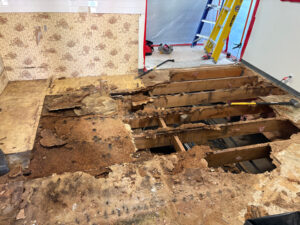
Step 4: Demolition and Material Removal (Hour 6-24)
Materials too wet or contaminated to dry get removed in this phase. That includes saturated insulation, swollen baseboards, warped engineered wood flooring, and Category 2/3 carpet pad. The technician documents everything photographed and noted on the work order — required for your insurance claim. For Fort Collins homes built on slabs, technicians may drill weep holes through baseboard cavities to release water trapped behind walls.
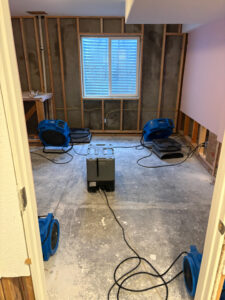
Step 5: Drying and Dehumidification (Day 1-5)
This is the heart of the job and the part homeowners least understand. Drying requires three things working together:
Air movers
High-velocity fans positioned to flow air across wet surfaces. The number is calculated based on square footage and material — typically 1 air mover per 50-150 square feet. They run continuously for 3 to 5 days.
Commercial dehumidifiers
These pull water vapor out of the air so the moisture from drying surfaces does not redeposit elsewhere. LGR (low grain refrigerant) units are standard. One properly-sized unit covers about 750-1,500 square feet of affected area.
Daily moisture readings
A technician returns daily to take readings on every wet material with a pin meter or non-invasive sensor. They log readings, adjust equipment, and update the moisture map. The job is not done until materials hit drying targets — within 10% of unaffected similar materials , equilibrium for concrete.
Step 6: Cleaning, Sanitizing, and Antimicrobial (Day 4-6)
Once materials are dry, surfaces get cleaned and treated to prevent microbial growth. Category 1 jobs may only need a basic antimicrobial wipe-down. Category 2/3 jobs require full disinfection per EPA mold cleanup guidance and may include HEPA vacuuming, air scrubbing with HEPA-filtered negative-air machines, and content cleaning of any salvageable items.
Step 7: Reconstruction (Week 2-6)
Reconstruction puts everything back. New drywall, paint, baseboards, flooring, cabinet replacement, and any custom work. Best Option Restoration of Fort Collins keeps the same project manager from mitigation through reconstruction so the homeowner does not get handed off to a different team mid-job. Reconstruction timelines vary widely — a single-room job is 1-2 weeks, a whole-floor flood rebuild is 4-8 weeks.
What to Watch For During the Process
Five things separate a good Fort Collins water damage job from one you regret:
Written IICRC S500 documentation on the work order
Ask to see the lead technician’s IICRC certification and confirm “IICRC S500” is referenced on your work order or scope of work. Companies that follow the standard list it openly. Companies that don’t usually deflect with phrases like “we follow industry best practices.” A written reference protects you if there’s an insurance dispute later about whether the work met the recognized standard.
Daily moisture readings logged on paper, not verbal updates
You should receive — or be able to ask for — a moisture log showing readings for every wet material, taken every day, on a moisture map of the affected area. Readings should drop 2 to 4 percentage points per day on normal materials. If a tech says “looks good, we’re drying it out” without showing numbers, that is a red flag. Stagnant readings after day 2 mean equipment quantity or placement needs adjustment — not a longer wait.
Equipment running 24/7 until drying targets hit
Air movers and dehumidifiers should never be turned off during the drying phase, not at night, not because they are loud, not to save on the electricity bill (the restoration company covers that or your insurance does). Every hour equipment is off extends the job and gives mold a foothold. If you come downstairs in the morning and the fans are silent, call the project manager immediately.
Photographed inventory of every removed material
Every piece of carpet pad, drywall cut, insulation bag, baseboard, and any salvageable contents removed from your home should be photographed before disposal and logged on the work order with square footage or linear footage. This is what your insurance adjuster needs to settle the claim, and it is your proof if a billing dispute comes up later. No photos, no documentation, no payment — that is a fair line to hold.
One project manager from emergency call through final reconstruction
The most common place jobs fall apart is the handoff between the mitigation crew (the team that dries the house) and the reconstruction crew (the team that rebuilds). Different companies, different scopes, different invoices, and details get lost — the wrong baseboard profile, paint that doesn’t match, a missed area behind a vanity. A single project manager owning the job start to finish prevents this. Ask up front: “Who is my single point of contact from today through the day my house is fully rebuilt?”
Drops in cleanly between “Step 7: Reconstruction” and “Common Causes of Water Damage in Fort Collins.” Tone, sentence cadence, and subheading style match the rest of the article.
Common Causes of Water Damage in Fort Collins
Frozen pipe bursts
Fort Collins winters drop below zero multiple nights each year. Pipes in exterior walls, garages, and crawlspaces freeze, expand, and split. Most bursts happen as the pipe thaws, not while frozen. Bathroom and kitchen supply lines on north-facing walls are the most common.
Ice dams and roof leaks
Snow accumulation followed by mild days creates ice dams along roof eaves. Water backs up under shingles and drips into attics or wall cavities. Often discovered weeks later as ceiling stains.
Spring snowmelt and basement flooding
Older basements with stone or block foundations leak during heavy March-to-May runoff. Sump pump failure during the same period multiplies the damage.
Appliance failures
Washing machine hoses, ice maker lines, dishwasher inlets, and water heater tank failures cause about a third of residential water damage claims year-round. None of them care about season.
Frequently Asked Questions
How long does water damage restoration take in Fort Collins?
Mitigation (steps 1-6) takes 3 to 7 days for typical residential jobs. Reconstruction adds 1 to 8 weeks depending on scope. Whole-house floods can run 6 to 12 weeks total.
Will my insurance cover water damage restoration?
Most Colorado homeowners policies cover sudden, accidental water damage from internal sources — burst pipes, appliance failures, ice dam infiltration. Excluded: gradual leaks, sewer backup (without a separate endorsement), and ground flooding (requires a flood insurance policy).
Can I dry it myself with box fans and save money?
For a single small spill caught within hours — yes. For anything that has soaked carpet pad, traveled into walls, or sat more than 24 hours — no. Box fans push moisture into wall cavities where it grows mold within days. The mold remediation bill that follows usually exceeds what professional drying would have cost.
What is the 24-48 hour mold rule?
Mold colonies start forming on wet organic materials within 24 to 48 hours. After 72 hours, established mold growth is likely. Professional water damage restoration aims to begin drying within 24 hours specifically to beat this clock.
How do I know if drying is actually working?
Daily written moisture readings should drop 2 to 4 percentage points per day for normal materials. If readings stagnate after day 2, equipment placement or quantity needs adjustment. Always ask to see the moisture log.
Fort Collins Homeowners Here’s your Next Move
Knowing the process is the difference between trusting your contractor and feeling like you are being upsold. Demand the IICRC S500 standard. Ask for daily moisture readings. Make sure equipment runs 24/7. Get photo documentation. Beat the 48-hour mold clock by calling early.
If you have water damage in your Fort Collins home right now, call Best Option Restoration of Fort Collins for 24/7 emergency response. Our IICRC-certified team handles every step from water extraction and drying through mold prevention and full reconstruction — all under one roof, with one project manager.